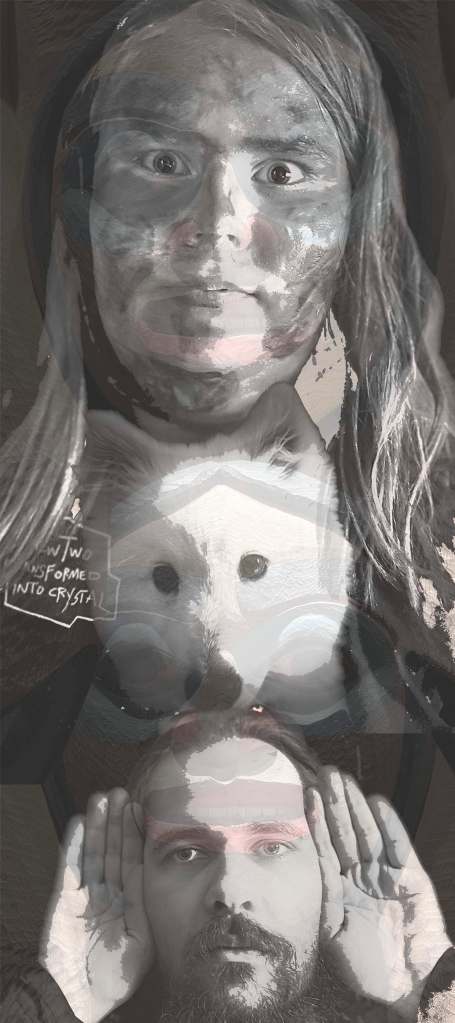
The inspiration for Voimapuu came from the exhibition theme “Roots” and a visit to the Burke Museum at the University of Washington in Seattle, where it was displayed. The Tlingit people of Harriman’s 1899 expedition from Alaska had carved columns, known as “house posts” or totems, that were taken from their villages. In 2001, the museum returned these totems to Saanya Kwá during a clan property healing ceremony. The museum commissioned Tlingit master carver Nathan to create new wooden posts. These new posts, crafted by Jackson and his son, Stephen Jackson, depict the Tlingit story of Teikweidi—a tale about a grizzly bear that marries a human hunter named Kaats and has children with him. This story about the totem made me think of Finnish folklore, particularly the significance of power trees known in various ways. The Mänty (also known as honka or petäjä) is associated with bear worship. Karsikkomanty is a tree dedicated to the deceased; it is pruned so that only fresh branches remain. When a dignitary dies, the lowest fresh branch is cut and sacrificed at the tree’s roots. Eventually, the unbranched wood turns into a “shrub” that marks the years of death within the home. We also discussed how the moon observes construction sites and the owner’s perspective on the habitability of those places at night. As a world tree, the birch represents the connection between life and death. This artwork is a living power tree that embodies family roots that need to be rebuilt. As people move from one place to another, their power animals may also change over time. Therefore, we must find new ways to connect with our home regions. The power tree artwork acknowledges and honours the Tlingit clans, emphasizing the value of tradition as well as the present, connecting ancestors with the current generation and the future.
Roots – Joint exhibition of the staff of the Faculty of Arts of the University of Lapland Galleries Valo ja Katve 1 and 2, Arktikum 18.8.-9.10.2022


